Triphop Display Typeface for Handmade Creators
If you’ve ever spent hours searching for a font that feels both nostalgic and fresh—something that whispers “peace, love, and handmade charm” without looking dated or hard to read—you’ll understand why Triphop landed on my worktable and hasn’t left. As someone who designs printable wall art, hand-stamped tags, wedding welcome signs, and small-batch product labels, I need fonts that do more than look pretty: they need to cut cleanly on my Cricut, print crisply at 12pt on kraft sticker paper, and still feel intentional when scaled up for a 24x36” farmhouse sign.
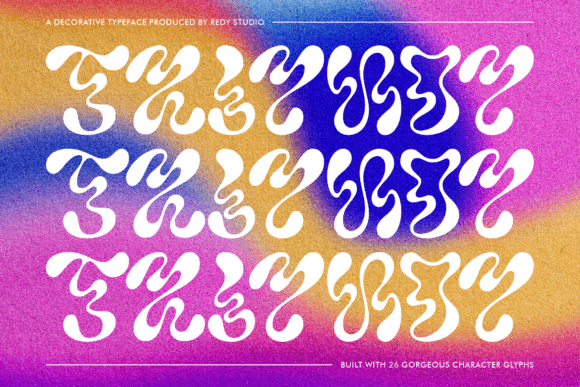
Triphop is a display typeface rooted in the joyful rebellion of 1960s typography—but it’s not a costume. It carries the warmth of hand-drawn lettering, with gentle curves, subtle flares, and balanced spacing that keeps it legible even at smaller sizes. The lowercase ‘a’ and ‘g’ have friendly, open shapes; the uppercase letters hold presence without shouting. There’s no excessive swirl or exaggerated contrast that breaks down during vinyl cutting or inkjet printing. That balance—vintage soul meets modern utility—is exactly what makes Triphop work so well across physical and digital craft projects.
I use Triphop most often for short, high-impact text: product names on candle jars, boutique gift tags, invitation headlines, and greeting card sentiments. It shines brightest where you want instant emotional resonance—think “Hand-Poured Soy Candle,” “Welcome to Our Wedding,” or “Summer Solstice Sale.” Because it’s a display font, it’s not meant for long paragraphs—but that’s perfect for how we actually design handmade goods. You wouldn’t put a full poem in a decorative font on a sticker, and Triphop respects that boundary. Its rhythm and weight make titles feel considered, not cluttered.
For practical production, I’ve tested Triphop across several real-world scenarios: cutting thin vinyl for mason jar labels (it held fine detail down to 8mm height), printing on matte sticker sheets (no ink bleed or fuzzy edges), and rendering in mockups for Etsy listings (it reads clearly even in thumbnail size). On Silhouette Studio and Cricut Design Space, the clean vector outlines convert smoothly—no jagged corners or stray nodes. Just be sure to convert to outline before sending to your machine if you’re using any alternate characters or ligatures (more on those in a moment).
What sets Triphop apart from other retro-inspired fonts is its built-in versatility. It includes stylistic alternates—like a swash ‘Q’ or a flourished ampersand—that add personality without sacrificing cohesion. I use those sparingly: one swash character per tag, maybe two per invitation suite. And yes—it supports multilingual Latin-based languages (including accented characters for Spanish, French, and Portuguese), which matters if you sell bilingual baby shower invites or café merchandise with “Buenos Días” signage.
Font pairing is where Triphop really sings. I almost always pair it with a clean, neutral sans serif—think Montserrat, Poppins, or Lato—for body text, ingredient lists, or care instructions. That contrast lets Triphop carry the visual weight while keeping information scannable and trustworthy. For wedding stationery, I’ll layer it over a soft script font (like Quicksand or Pacifico) for names, then drop back to a simple serif like Merriweather for RSVP details. The result? A cohesive brand voice that feels human, intentional, and commercially polished.
Here’s where I reach for Triphop most:
- Candle & soap labels: “Lavender + Sage” looks earthy and elevated—not kitschy—especially when set in all caps with generous letter spacing.
- Wedding welcome boards: Paired with a light gray background and dried florals, Triphop gives that warm, inclusive vibe guests remember.
- Digital printables: Planner headers, quote cards, and seasonal checklists gain instant character without overwhelming layout.
- Tote bags & tea towels: Screen-printed or heat-transferred, it holds up beautifully at medium scale—no pixelation, no lost detail.
- Holiday packaging: “Merry & Bright” on kraft gift boxes feels festive but grounded, not cloying.
One thing I always double-check before launching a new product: licensing. Triphop comes with a commercial license that covers physical goods (stickers, mugs, apparel), digital downloads (PDF templates, SVG files), and client work—including custom invitations or shop branding. That means you can bundle it into your Canva template shop, include it in your Cricut-ready SVG pack, or use it to design labels for your Etsy candle line—no extra permissions needed. Just keep your license file handy and avoid uploading the raw font file directly to platforms that allow font uploads (like some POD sites).
It’s also worth noting that Triphop ships in OTF and TTF formats—so it works seamlessly whether you’re designing in Adobe Illustrator, Procreate, Affinity Designer, or free tools like Canva (via upload). No font substitution surprises, no missing glyphs. And because it’s a single-weight display font—not an entire family—you won’t waste time sifting through 12 variations trying to decide which bold or light version fits. What’s included is purpose-built, refined, and ready.
In a market flooded with “vintage” fonts that sacrifice clarity for flair, Triphop stands out by honoring both craft and commerce. It doesn’t ask you to choose between authenticity and usability. It lets your handmade products speak with warmth, confidence, and quiet professionalism—whether that’s a $4 sticker or a $120 wedding suite. If your customers are drawn to intentionality, texture, and timeless joy—and if your workflow demands reliability—Triphop isn’t just another decorative typeface. It’s a tool that grows with your shop.